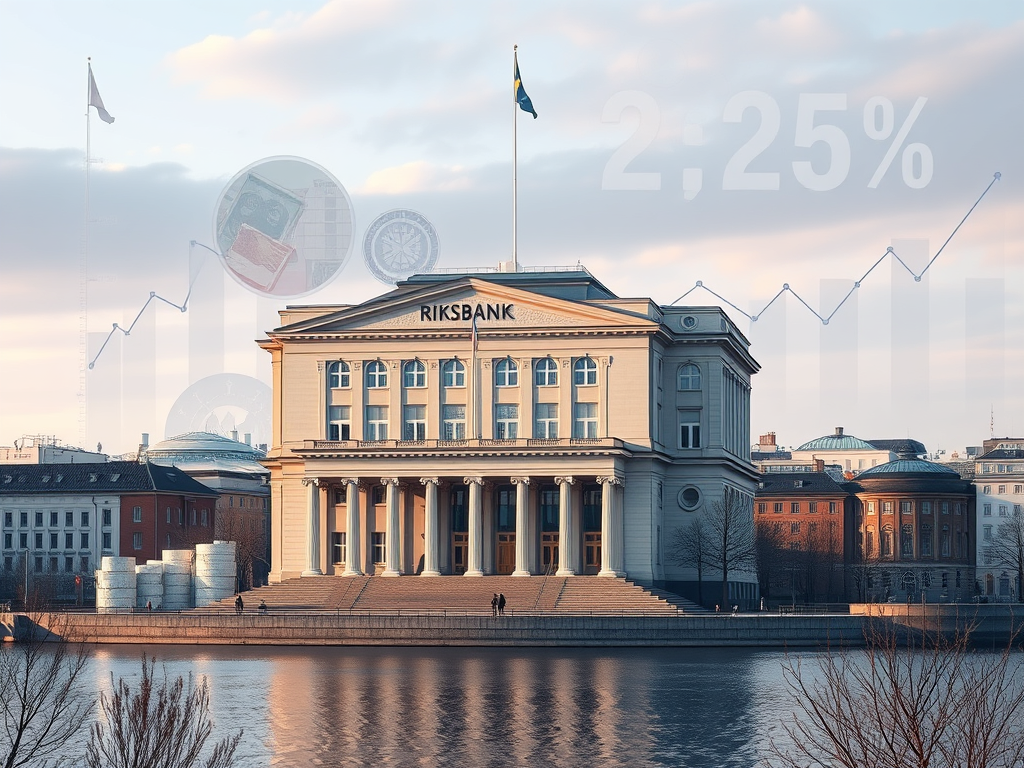
The Riksbank, Sweden’s central bank, plays a pivotal role in the country’s financial system, primarily through its management of the policy rate—an essential tool designed to maintain price stability, foster sustainable economic growth, and navigate periods of economic uncertainty. As of June 16, 2025, the Riksbank’s policy rate stands at 2.25%, a figure that has remained unchanged since February 5, 2025. This rate, while seeming like a simple number, carries significant implications for virtually every corner of the Swedish economy, from the cost of mortgages and loans to the rate of inflation and the overall pace of economic activity.
Thank you for reading this post, don’t forget to subscribe!2. To fully grasp the importance of the Riksbank’s policy rate, it’s essential to understand what this rate represents and how it influences both the broader economy and the everyday lives of Swedish citizens. The policy rate, sometimes referred to as the repo rate, is the interest rate at which banks can borrow money from the Riksbank or deposit funds with it. By adjusting this rate, the central bank can directly affect the cost of borrowing and the incentive to save, thereby influencing consumer spending, business investment, and inflation.
3. Historically, the Riksbank’s primary objective has been to maintain inflation close to its target of 2%. This target is considered optimal for promoting stable prices without stifling economic activity. When inflation rises above this target, the bank may increase the policy rate, making borrowing more expensive and saving more attractive, thereby cooling down consumer demand and slowing price increases. Conversely, if inflation falls below the target, the Riksbank may lower the policy rate to stimulate borrowing, investment, and spending, thus nudging inflation back up toward the desired level.
4. The current policy rate of 2.25% reflects a period of careful balancing by the Riksbank. In May 2025, Sweden’s inflation rate was measured at 2.3%, just a touch above the central bank’s 2% goal. This slight overshoot signals that while inflation is not running out of control, it remains a focal point for policymakers. According to Riksbank Governor Erik Thedeen, recent data have supported the central bank’s outlook that inflationary pressures are likely to ease as the year progresses. The Riksbank, therefore, has kept the policy rate steady, awaiting further confirmation that inflation is indeed trending downward before making any further moves.
5. But the policy rate is not the only interest rate set by the Riksbank. The central bank also determines a reference rate, which is crucial for various legal and financial calculations. For the period from January 1 to June 30, 2025, this reference rate has been set at 3.00%. This rate is recalculated twice a year and is influenced by the level of the policy rate. It serves as a benchmark for calculating default interest in legal disputes and is referenced in contracts and agreements across the Swedish economy.

6. The process by which the Riksbank sets its policy rate is both data-driven and forward-looking. Central bankers closely monitor a broad array of economic indicators: inflation, GDP growth, unemployment rates, wage trends, and international developments. They weigh these factors against their forecasts for future economic conditions, recognizing that changes in the policy rate can take months to fully filter through the economy.
7. The decision to hold the policy rate at 2.25% in early 2025 was informed by several key considerations. First, while inflation remained slightly above target, forward-looking indicators suggested a cooling trend. Energy prices, which had been volatile in previous years, began to stabilize. Supply chain disruptions, which had contributed to higher costs, showed signs of easing. Wage growth, while steady, was not accelerating to the point of risking a wage-price spiral. In this context, the Riksbank judged that there was no immediate need to either tighten or loosen monetary policy further.
8. However, the central bank did not rule out future adjustments. If inflation were to persist above target, or if economic growth were to surprise on the upside, the Riksbank might consider raising the policy rate to prevent the economy from overheating. Conversely, if data confirmed a steady decline in inflation and economic activity appeared to be slowing, the bank could lower the policy rate to provide additional support.
9. This cautious, data-dependent approach reflects the complexities of modern monetary policy. Central banks must not only respond to current economic conditions but also anticipate future developments. Missteps can have significant consequences: raising rates too quickly can stifle growth and increase unemployment, while keeping them too low for too long can fuel inflation and create asset bubbles.
10. The Riksbank’s policy decisions reverberate far beyond the central bank itself. When the policy rate changes, commercial banks adjust their own lending and deposit rates. For Swedish households, this means changes in mortgage interest rates, car loans, and savings account yields. A higher policy rate often leads to higher monthly payments for variable-rate mortgages, potentially squeezing household budgets. On the other hand, savers may benefit from higher returns on their deposits.
11. Businesses, too, feel the impact. Higher interest rates increase the cost of borrowing for investment and expansion, which can slow job creation and economic growth. Conversely, lower rates can spur business investment but may also encourage excessive risk-taking if left unchecked for too long.
12. The Riksbank’s influence also extends to the exchange rate of the Swedish krona. Changes in the policy rate can affect international capital flows, as investors seek the best returns available. A higher policy rate can attract foreign investment, strengthening the krona, while a lower rate may have the opposite effect. Exchange rate movements, in turn, influence the cost of imported goods and services, feeding back into inflation.
13. Internationally, the Riksbank’s policy decisions are made in the context of broader global trends. Central banks in Europe, the United States, and elsewhere are also grappling with the challenges of balancing inflation and growth. Coordination or divergence among these institutions can create additional challenges. For example, if the European Central Bank raises rates while the Riksbank holds steady, capital may flow from Sweden to the euro area, putting downward pressure on the krona and potentially importing inflation.
14. Sweden’s monetary policy framework is designed to promote transparency and predictability. The Riksbank regularly communicates its views through press releases, speeches, and detailed reports, outlining the rationale behind its decisions and its expectations for the future. This openness helps anchor inflation expectations among households, businesses, and investors—a critical factor in the effectiveness of monetary policy.
15. Looking ahead, the outlook for the Riksbank’s policy rate will depend on how economic conditions evolve. The central bank has signaled that if the current trends continue—specifically, if inflation continues to ease without significant deterioration in economic activity—further rate cuts may be on the table in the first half of 2025. Such a move would be designed to support growth and ensure that inflation remains anchored near the 2% target.
16. However, monetary policy is always subject to unexpected shocks. Geopolitical developments, sudden changes in global energy prices, or financial market volatility can quickly alter the economic landscape. The Riksbank remains vigilant, ready to adjust its stance as needed to fulfill its mandate.
17. For ordinary Swedes, the Riksbank’s decisions can sometimes seem remote or technical. Yet, their effects are felt in everyday life. For someone saving for retirement, the policy rate influences the returns they can expect on their savings. For a family buying a home, it affects the affordability of their mortgage. For a business owner, it shapes decisions about hiring and investment. In this way, the Riksbank’s stewardship of the policy rate is not just a matter of high finance—it is a cornerstone of Sweden’s economic well-being.
18. Over the years, the Riksbank has earned a reputation for prudence and adaptability. It was the first central bank in the world, founded in 1668, and has weathered centuries of economic change. Today, its commitment to low and stable inflation, combined with a willingness to respond flexibly to new challenges, continues to underpin Sweden’s prosperity.
19. In summary, the Riksbank’s current policy rate of 2.25% is a reflection of both present realities and future expectations. It represents a careful balancing act: supporting economic growth without letting inflation get out of hand. The central bank’s decisions are informed by a wide range of data and guided by a clear mandate. As the economic environment evolves, Swedes can expect the Riksbank to remain vigilant, transparent, and responsive, ensuring that monetary policy continues to serve the needs of the country.
20. Understanding the Riksbank’s policy rate is to understand the pulse of Sweden’s economy. It is a figure watched closely by economists, investors, businesses, and households alike—a small number with a big impact. Whether rates rise, fall, or hold steady, the central bank’s actions will continue to shape the financial landscape, steering Sweden through the challenges and opportunities of the years ahead.
21. In practical terms, this means that anyone with a loan, a mortgage, or savings in Sweden should keep an eye on the Riksbank’s announcements. When the policy rate changes, it can take time for the effects to filter through the economy, but those effects are real and significant. For example, a decrease in the policy rate can lead to lower mortgage rates, freeing up household income for other purposes and potentially boosting consumer spending. Conversely, an increase in the rate can have the opposite effect, reining in inflation but also slowing economic growth.
22. The Riksbank’s approach to setting the policy rate is often characterized by gradualism and caution. Sudden, large changes are rare, as the central bank seeks to avoid unnecessary disruption. Instead, it typically moves in small increments, carefully communicating its intentions to the public. This helps markets adjust smoothly and reduces the risk of unintended consequences.
23. One recent development worth noting is the Riksbank’s growing emphasis on forward guidance. By signaling its likely future actions, the central bank can shape expectations and influence economic behavior even before it changes the policy rate. For instance, if the Riksbank suggests that further rate cuts are possible in the coming months, banks and investors may begin to adjust their own rates and portfolios in anticipation, helping to transmit monetary policy more effectively.
24. This strategy relies on the bank’s credibility. If households and businesses believe that the Riksbank will act as it says, their expectations for inflation and interest rates will remain anchored, making it easier for the central bank to achieve its goals. Building and maintaining this trust is a key part of the Riksbank’s work.
25. The policy rate also interacts with other tools in the Riksbank’s arsenal. In times of severe economic stress, such as during the global financial crisis or the COVID-19 pandemic, the central bank has used unconventional measures like asset purchases and targeted lending programs to support the economy. While these tools are not in active use at present, they remain available should circumstances warrant.
26. Ultimately, the Riksbank’s policy rate is more than just a number—it is a signal of the central bank’s assessment of the Swedish economy and its commitment to stability and growth. By watching the policy rate and understanding the reasoning behind it, Swedes can gain valuable insight into the health of the economy and the likely direction of future financial conditions.
27. In conclusion, as of June 2025, the Riksbank’s policy rate of 2.25% stands as a testament to its careful stewardship of the Swedish economy. It reflects a nuanced understanding of current conditions and a readiness to adapt to whatever the future may hold. Whether rates rise or fall in the months ahead, the central bank’s actions will continue to shape the lives of all who live and work in Sweden, guiding the nation towards a stable and prosperous future.
Leave a Reply